
7 Types of Watch Clasps Every Watch Lover Should Know
All watches have some type of closure to keep the watch secure on the wrist. It’s known as a clasp. The clasp is one of the most important parts of a watch, as it plays a significant role in keeping your watch securely fastened to your wrist. There are various types of watch clasps available, each with its own unique benefits and features.
In this comprehensive guide, we will explore the different types of watch clasps available in the market, from traditional buckles to modern deployant clasps and everything in between. Whether you are a seasoned watch enthusiast or new to the world of watches, understanding the various types of watch clasps and their usage will enhance your overall watch-wearing experience.
Contents
1. The Folding Clasps
The folding clasp is one of the most popular and widely used types of watch clasps. It consists of three sections connected by two hinges, allowing it to fold over itself when closed. To open or close the clasp, you simply loosen and push the flap. Some folding clasps feature an additional safety flap, particularly found on dive and sports watches, to provide extra security and prevent accidental openings.
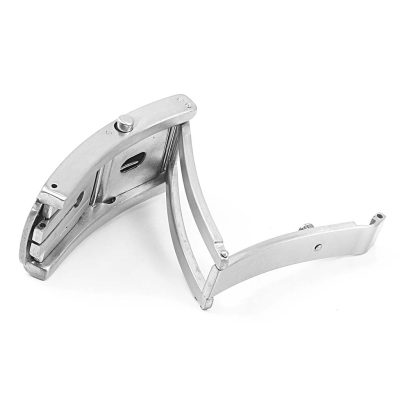
These clasps are favored for their simplicity and ease of use. They complement a wide range of bracelet designs and can be seamlessly integrated into various watch styles. Most folding clasps are equipped with multiple pin holes on each side, enabling you to make small adjustments to the bracelet’s size for a more customized fit.
Note: Some companies also manufacture plastic & carbon fiber folding clasps but these are not as commonly used as metal ones.
We can further classify the folding clasps into two types by considering the push buttons used in a clasp.
- Single Push-Button Folding Clasps
- Double Push-Button Folding Clasps
You can also call it an evolution in folding clasps.
Single Push-Button Folding Clasps
These clasps, as the name implies, are folding clasps that open and close with a single push button. These clasps typically consist of two metal plates, with one plate featuring a hook that securely fits into a corresponding hole on the other plate. When the clasp is closed, the hook is securely held in place by the hole, and to open it, you simply need to press the button located on the side of the clasp. The main advantage of using a push button in a clasp is to make it easier to open and more secure when closed.
Double Push-Button Folding Clasps
The mechanism of the double push-button folding clasp is similar to the single push-button clasp but it has two push-buttons on either side of the clasp, making it much more secure.
2. The Deployant Clasps
The terms “deployant clasp” and “folding clasp” are often used interchangeably, although there is a slight distinction between the two. While both types operate on a folding mechanism, deployant clasps are specifically designed for use with leather and non-metal straps.
The credit for the invention of the deployant clasp goes to Louis Cartier, a renowned French jeweler, who introduced it in 1904. He named it the “deployant” clasp, derived from the French word “déployant,” meaning “to unfold.”
A deployant clasp typically consists of a metal pin buckle on one end that inserts into one of the holes on the larger side of the strap. The other end of the clasp is connected to the shorter side of the strap using a spring bar. Depending on the design, deployant clasps can feature a single folding section, two folding sections, or even three folding sections in the middle. By considering the folding sections, we can classify deployant clasps into three types:
- Single-Fold Deployant Clasp
- Double-Fold Deployant Clasp or Dual Deployant Clasp
- Tri-Fold Deployant Clasps
Like the folding clasps, the deployant clasps also come with a single push-button and a double push-button feature. By considering the push- buttons, we can further classify deployant clasps into two types:
- Single Push-Button Deployant Clasp
- Double Push-Button Deployant Clasp
The deployant clasp is typically sold as a separate accessory and is not commonly included with watches. Many individuals opt for a deployant clasp over a traditional pin buckle for two primary reasons. Firstly, the deployant clasp offers a more refined and elegant appearance, adding a touch of sophistication to the overall aesthetic.
Secondly, and perhaps more importantly, the deployant clasp provides ease of use when it comes to opening and closing the clasp, while also preserving the lifespan of the strap. In contrast, the repeated use of a pin buckle can cause wear and tear, leading to damage and scratches on the strap over time.
3. The Butterfly Clasps
The butterfly clasp shares a similar mechanism to the deployant clasp, featuring two small metal pieces connected by hinges to a large central piece. When the clasp is closed, the two small pieces fold over the large middle piece, concealing all metal components within the bracelet when worn on the wrist. Its name, “butterfly clasp,” is inspired by the resemblance of its opening and closing process to that of butterfly wings.
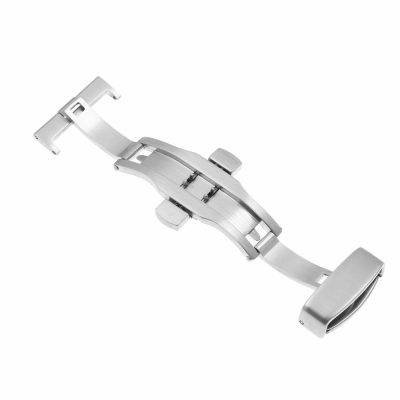
This type of clasp is suitable for both metal bracelets and non-metal straps. When used with non-metal straps, it includes a metal pin buckle on one end, allowing it to be inserted into the holes on the larger side of the strap and adjusted for a personalized fit. Similar to other clasps, the butterfly clasp incorporates a push-button locking mechanism for added security.
4. The Jewelry clasps
The jewelry clasp is a minimalist and straightforward type of watch clasp. Comprising two small metal pieces connected by a hinge, it is attached to one side of the bracelet. To wear the bracelet, you simply close the clasp by inserting one metal piece through the hole on the other side and gently pressing it down. Once closed, it seamlessly blends with the bracelet, resembling an additional link.
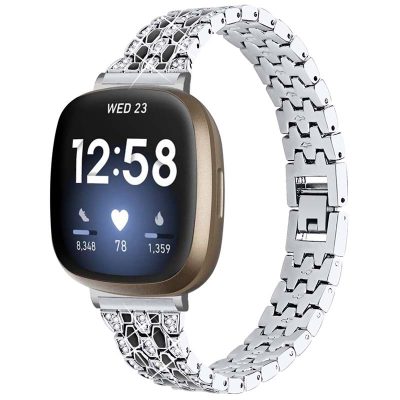
It is specially designed for women’s watches because it is not bulky on the wrist and has a smaller opening than other watch clasp types. The one downside of the jewelry clasp is that it can’t be adjusted for the perfect fit. You have to resize the bracelet by removing its links to fit your wrist.
5. The Tang Buckles (Pin Buckles)
Tang buckles, also known as pin buckles, are the most commonly used type of watch clasp. This is because they are cost-effective and easy to operate. Tang buckles comprise a frame, a pin, and a bar. The frame is generally rectangular or oval in shape, with the pin positioned in the center and the bar linking the frame and the pin. To secure the buckle, the pin is inserted into the holes on the larger side of the strap.
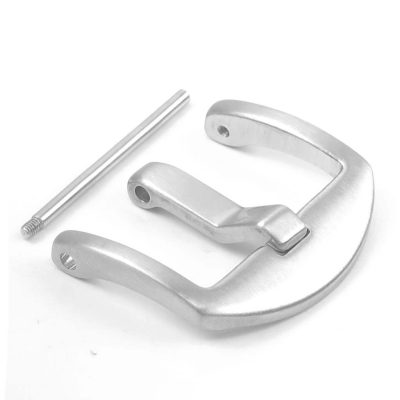
Pin buckles are suitable for use with rubber, leather, plastic, and NATO fabric straps. They are often made of metals such as stainless steel, although some low-cost watches may have plastic buckles.
6. The Magnetic Clasps
Magnetic clasps are a modern and convenient alternative to traditional watch clasps. They use the power of magnets to secure the bracelet in place. The clasp is composed of two parts: one with a magnet and the other with a metal piece that is attracted to the magnet. When brought close together, the magnetic force ensures secure closure. They usually come with Milanese Mesh bracelets.
Magnetic clasps are known for their ease of use, allowing for quick and effortless fastening and removal of the watch. However, it’s important to note that magnetic clasps may not be suitable for all watches, particularly those with mechanical movements, as the magnetic field can interfere with the functioning of the watch.
7. The Slide Clasps
A slide clasp, also known as a sliding clasp or adjustable clasp, is a versatile type of watch clasp that offers adjustable sizing for a comfortable fit. It consists of two separate pieces that slide along the strap to adjust the length. One piece has a series of notches or holes, while the other piece has a small bar or pin that fits into the desired notch.
By sliding the pieces along the strap and securing them in place, you can customize the size of the bracelet to fit your wrist perfectly. Slide clasps are popular for their flexibility and ease of adjustment. Due to their secure fit, they are ideal for sports watches with metal bracelets and rubber straps.
Note: All of the metal clasps mentioned above are available in a variety of finishes like polished, brushed, and PVD coatings. When purchasing a clasp for your watch, be sure to select the finish that best complements the finish of your watch bracelet.
Conclusion
In conclusion, watch clasps come in a variety of styles and types, each with its own unique features and advantages. From the simple yet elegant jewelry clasp to the sophisticated deployant and butterfly clasps, there is a clasp for every preference and need. Remember to consider the materials, design, and compatibility with your watch bracelet when choosing the right clasp. By selecting the appropriate clasp, you can enhance the comfort, security, and overall appeal of your timepiece.
This was really helpful, thank you! As someone with thinner wrists, I’m wondering if you have any specific tips or recommended brands for finding shorter watch bracelets that still have removable links? Or specific clasps that work well for smaller wrists? Trying to find a good fit.
Good question, Robert! Some brands that work well for thinner wrists are Nomos, Junghans, Cartier, and Oris – they make great micro-adjustable clasps and proportionally curved bracelets. You can also look for half-link style bracelets, or aftermarket short length options on sites like Strapcode and StrapsCo.